Back
Back
CE / CME
DeLIVERing Prevention: Optimizing Uptake of Hepatitis A and B Vaccination
Pharmacists: 1.00 contact hour (0.1 CEUs)
Physicians: maximum of 1.00 AMA PRA Category 1 Credit™
Nurse Practitioners/Nurses: 1.00 Nursing contact hour
Released: June 03, 2026
Expiration: June 02, 2027


Activity
Overcoming Logistical Barriers
Jewel Mullen, MD, MPH, MPA, FACP:
As both a primary care physician and a public health practitioner, I often return to the idea that vaccines are among the greatest public health achievements of the 20th century. The reductions in morbidity and mortality from vaccine-preventable diseases are outcomes we do not want to see reversed. Ensuring that everyone has access to vaccination continues to be critically important.
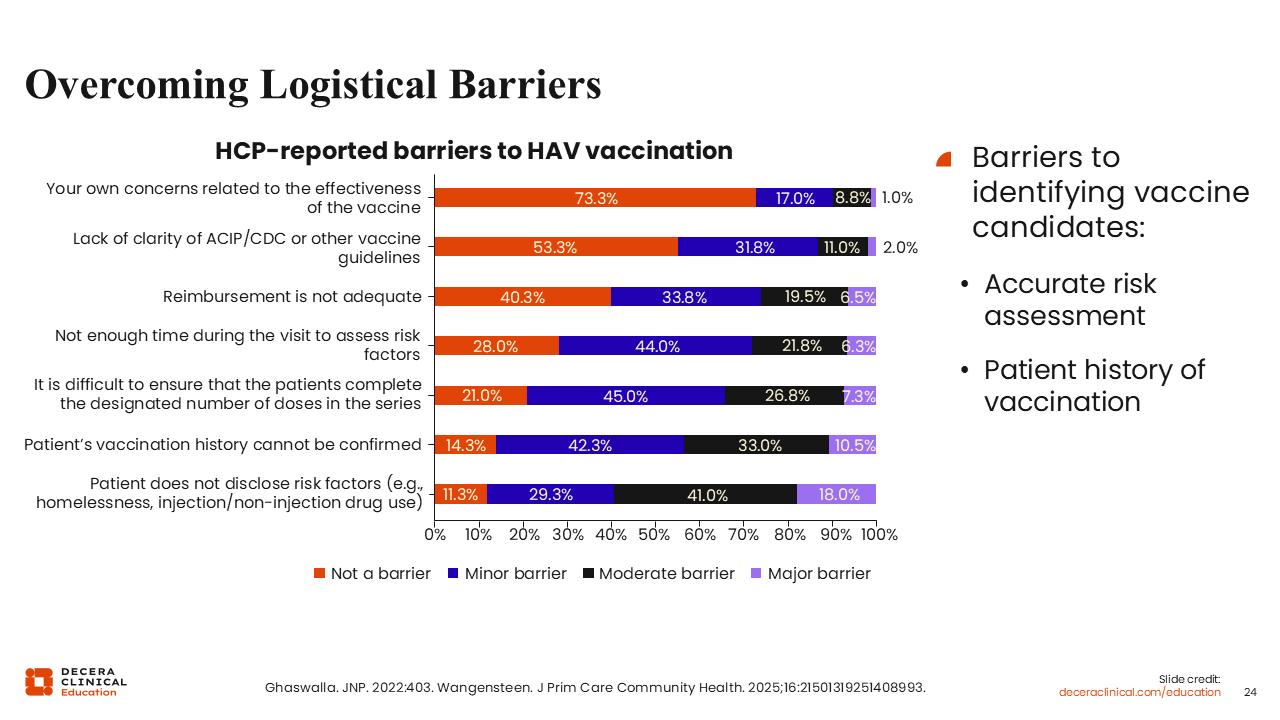
Various studies have evaluated barriers to vaccination from the HCP perspective. Lack of clarity regarding guidelines continues to be a barrier. Although changing recommendations can be challenging, I often encourage HCPs to rely on guidance from their professional societies, state health departments, and organizations such as AAP and ACIP, while reinforcing that the underlying evidence supporting vaccination has not changed.41,42
Concerns regarding reimbursement also remain important, particularly as we navigate vaccine coverage across Medicaid, Medicare, and other programs.41,42
Time constraints are another major challenge in primary care practice. However, vaccine promotion is ideally the work of the entire practice environment. Receptionists, medical assistants, nurses, and other staff members all have important roles in creating a practice culture that supports vaccination and identifies patient concerns early without introducing additional uncertainty.41,42
Su Wang, MD, MPH, FACP:
One logistical challenge that stands out to me is uncertainty regarding vaccine history. Patients often are not sure whether they received 1 dose or completed a series, and that can complicate decision-making.
I encourage patients to keep vaccine records accessible, even if that simply means storing information on their phones. Increasingly, pharmacies interface with electronic medical records, although integration is still incomplete.
It is also important to remember that these vaccines are safe even if an extra dose is administered. In many situations, proceeding with vaccination is preferable to leaving a patient unprotected.
Paul Kwo, MD:
I agree completely. As electronic health records continue to evolve, interoperability with pharmacies and other healthcare systems will improve vaccine tracking.
In my practice, we work closely with primary care physicians to ensure that evaluation of liver disease includes protective serologies. In addition to HBV screening panels, we frequently assess total HAV antibody status because even in areas where HAV is relatively endemic, susceptible individuals still require vaccination.
Su Wang, MD, MPH, FACP:
That is an excellent point. I often incorporate serologic testing for HAV, HBV, hepatitis C virus, and HIV into routine preventive care. Using a more universal approach rather than focusing only on risk factors can help normalize screening and vaccination discussions.
Increasing Vaccine Uptake in High-Risk and Underserved Groups
Jewel Mullen, MD, MPH, MPA, FACP:
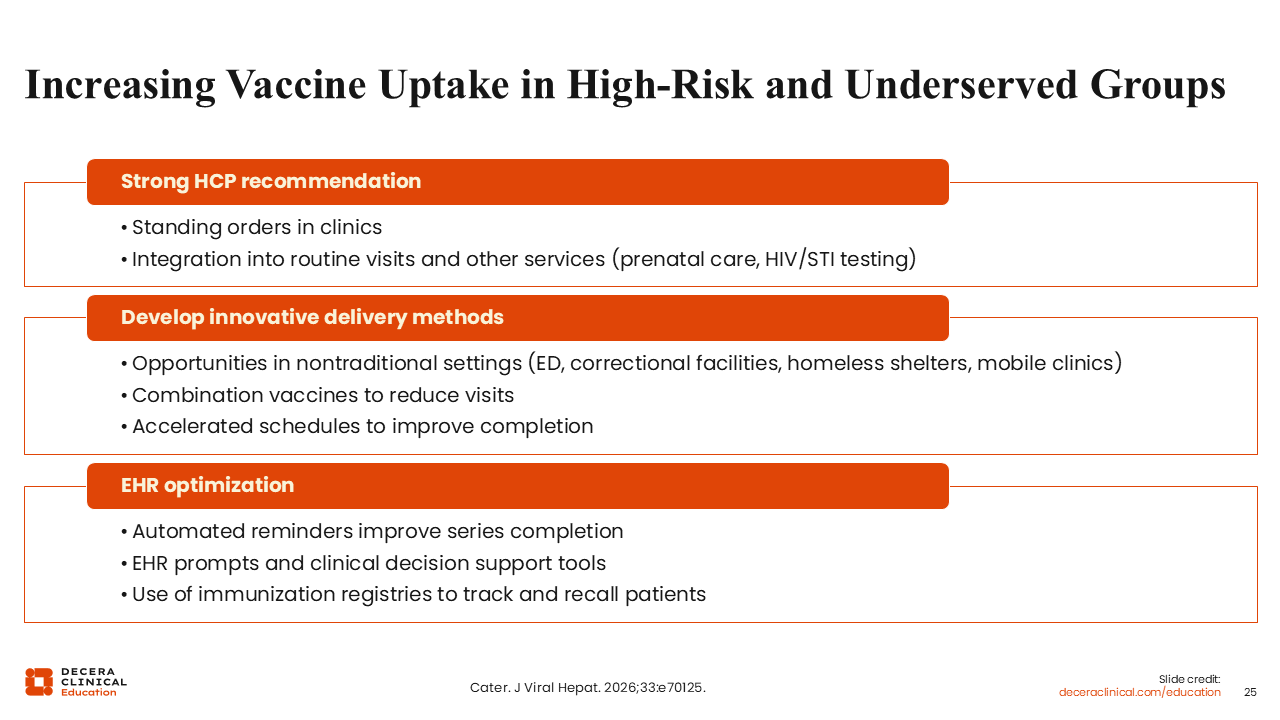
Earlier, we discussed the importance of identifying high-risk and underserved populations. To increase vaccine uptake in these key communities, strong HCP recommendations remain essential and should not disappear, even within shared clinical decision-making frameworks.43
Shared clinical decision-making models often include evaluating a patient’s choice after discussion. That creates an opportunity to acknowledge a patient’s perspective while also communicating an HCP’s strong evidence-based recommendation.43
There are other ways to help underserved groups:
- Standing orders are also important because they allow vaccination opportunities to continue even if a patient initially declines. Revisiting the vaccine discussion at a future appointment allows patients the chance to change their minds. Every clinical encounter should be viewed as an opportunity to revisit preventive services such as vaccination.43
- Innovative delivery methods are becoming increasingly important as healthcare systems collaborate with community organizations, correctional facilities, homeless shelters, and public health agencies. These partnerships help identify at-risk individuals, initiate vaccination, and support continuity of care so vaccine series can be completed across care settings.43
- Coadministration of vaccines can also simplify care and reduce the need for multiple visits. Accelerated vaccine schedules may improve completion rates as well.43
- Electronic health records continue to play an important role through reminder systems, clinical decision support tools, and immunization registries.43
Su Wang, MD, MPH, FACP:
I find that scheduling the next appointment before the patient leaves is extremely helpful. Patients often intend to return but may forget if follow-up is not already arranged.
It is also useful to remind patients that HBV vaccination is now available as a 2-dose series completed within 1 month, which has improved completion rates compared with longer schedules.43
Jewel Mullen, MD, MPH, MPA, FACP:
Cost also remains a practical barrier. HCPs may not always know what vaccines are covered under various payer systems. Coordinating with pharmacies, public health departments, and assistance programs can help reduce cost-related barriers and improve access.43
Addressing Vaccine Hesitancy
Jewel Mullen, MD, MPH, MPA, FACP:
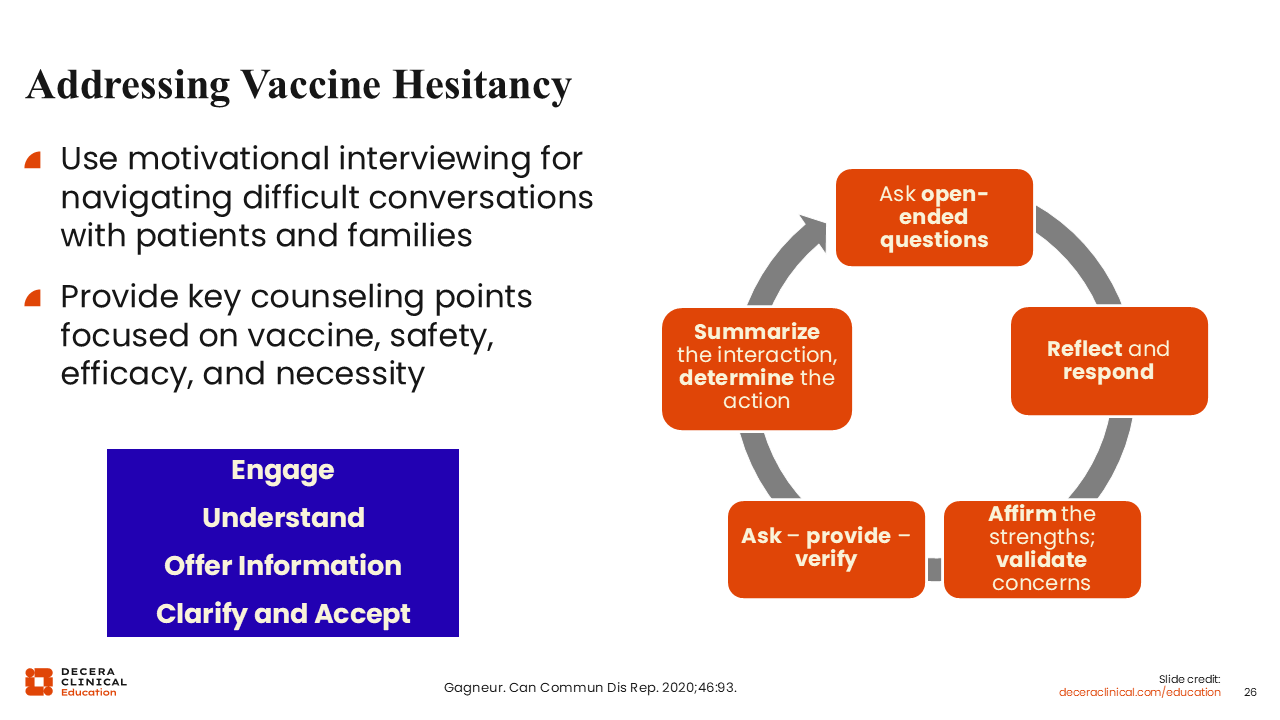
Considering all the potential barriers to vaccination faced by vulnerable, underserved populations, it should be no surprise that vaccine hesitancy can arise for many different reasons. To address hesitancy effectively, it is important not to assume that every patient’s concerns are the same.
Some patients may have concerns related to safety, language barriers, misinformation, access, convenience, or prior healthcare experiences. Providing information in a way that meets patients’ individual needs is essential.44
These conversations should create space for patients to ask questions and express concerns. Responding in a culturally humble manner is important, recognizing that there is no single approach that applies to every patient or community.44
Ultimately, combining empathetic communication with a strong recommendation can help vaccination discussions feel supportive rather than directive.
Su Wang, MD, MPH, FACP:
I think this is incredibly important because I have noticed that the way recommendations are communicated in the exam room matters just as much as the recommendation itself.
For example, patients may feel hesitant about receiving multiple vaccines during a single visit. In those situations, we often help prioritize based on individual clinical risk. If a patient can receive only 1 vaccine at that visit, we may recommend the vaccine most strongly supported by their risk profile.
That is part of helping patients navigate these decisions while still emphasizing evidence-based prevention.
Paul Y. Kwo, MD:
I also find that many patient concerns center on vaccine safety, especially in the setting of newer vaccines and widespread misinformation.
One important point regarding the HAV and HBV vaccines is that these vaccines have extensive long-term safety data, including in infants and pregnant women. There is an enormous body of evidence demonstrating that these vaccines are safe and highly beneficial, particularly for individuals with liver disease.
Jewel Mullen, MD, MPH, MPA, FACP:
That also reinforces the importance of maintaining a nonjudgmental environment during these discussions. Patients who are uncertain about vaccination and vaccine safety should feel comfortable asking questions without feeling judged. At the end of the day, we both have the same priority, which is keeping our loved ones and ourselves safe and healthy.
However, not every hesitant patient is concerned with safety or vaccine misconceptions. Patients may want to accept vaccination, but face logistical barriers related to cost, transportation, time, or convenience. That is why the conversation itself remains so important.
Meet People Where They Are
Jewel Mullen, MD, MPH, MPA, FACP:
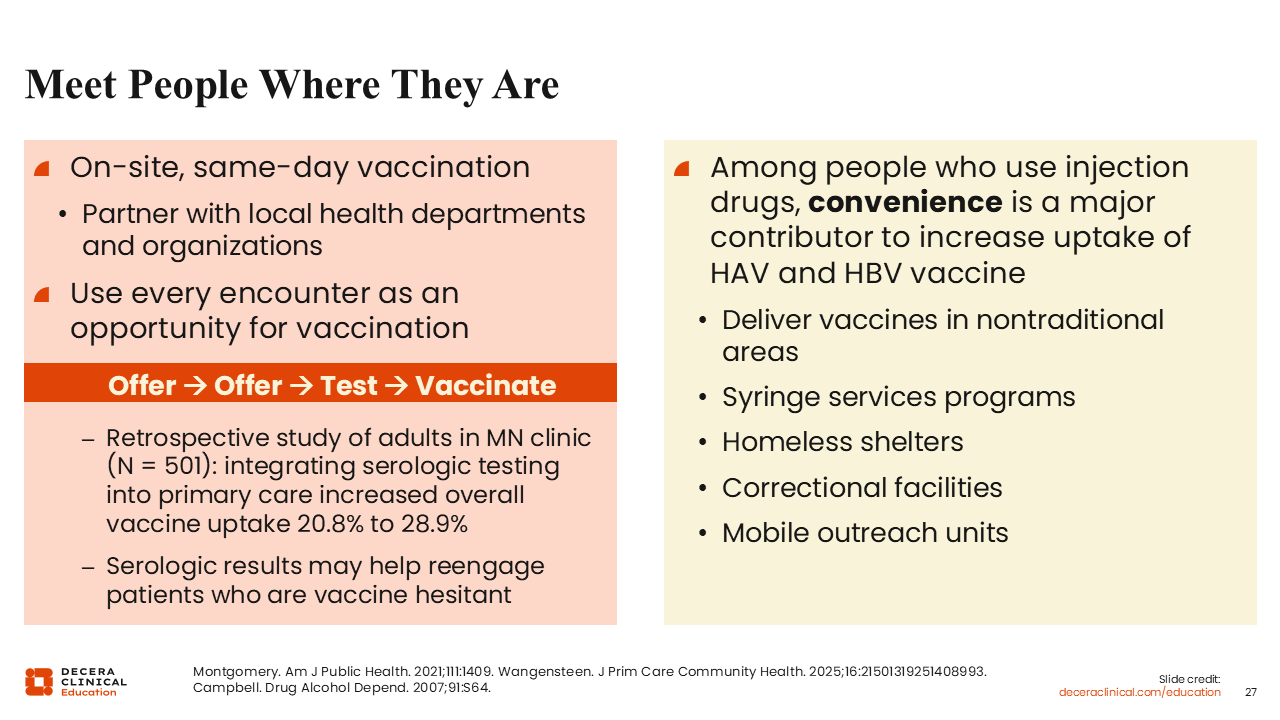
It is important to meet people where they are and to use every encounter as an opportunity for vaccination.
Patients may return to a clinic or healthcare system for many different reasons, and each interaction creates another opportunity to revisit vaccination if needed.42
Partnerships with local health departments, aging agencies, correctional facilities, homeless shelters, syringe services programs, and mobile outreach programs are increasingly important for improving access to vaccination among high-risk populations.45
Convenience also plays a major role in vaccine uptake, particularly among individuals who use injection drugs or who have unstable housing. Vaccination efforts in nontraditional settings can help reduce missed opportunities and improve completion of vaccine series.46
Assessing serologies can also help patients better understand their immunity and individual risk.42
Su Wang, MD, MPH, FACP:
Recall that for some high-risk populations, vaccination may proceed even without prior serologic testing. As a primary care physician, we often prefer to determine serologic status first, but in these settings, the priority is to avoid missing the opportunity to vaccinate because follow-up may not occur.
Paul Y. Kwo, MD:
Particularly among individuals with unstable housing or other significant barriers, the clinic visit may be the only opportunity to vaccinate.
Jewel Mullen, MD, MPH:
Ultimately, we want to help reassure our HCP colleagues out there in the practice world that they should feel confident going forward and supported by science and their professional societies with navigating patient-specific vaccine decisions.