Ask AI

Advancing the Early Detection of Lung Cancer: Improving Awareness and Implementation of Low-Dose CT Screening

Clinical Thought
Clinical Thought Start Activity

Released: October 11, 2026

See Activity Collection

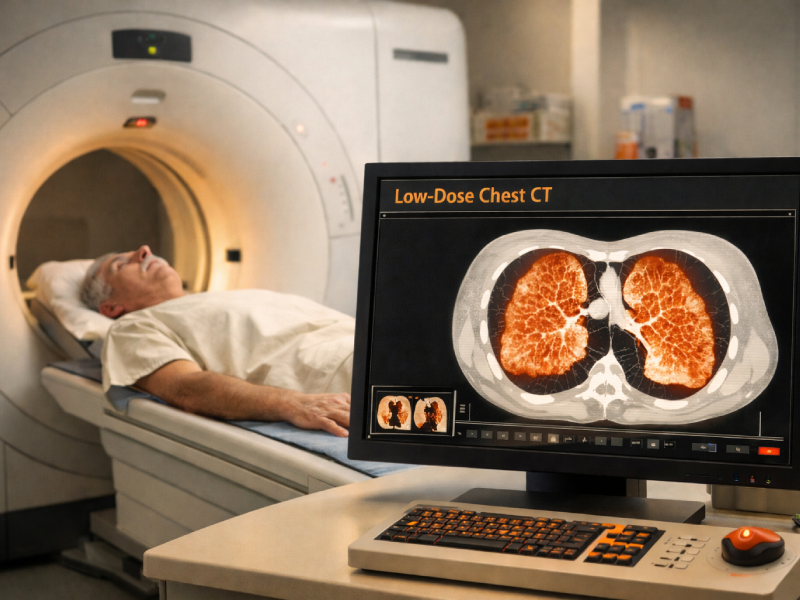
This expert commentary discusses insights gained from our educational program addressing low-dose CT screening for the early detection of lung cancer. Despite the substantial burden of lung cancer in the United States, use of low-dose CT screening among eligible individuals remains low. Experts examine current eligibility criteria, strategies to improve screening among underserved populations, and emerging approaches to lung cancer risk assessment and detection. They also consider patients who do not clearly meet current USPSTF screening criteria but may be at higher risk for lung cancer, including how additional risk factors may inform decisions about low-dose CT screening.


Low Dose CT Screening

Recent educational initiatives have focused on improving the use of low-dose computed tomography (CT) screening among eligible individuals at high risk for lung cancer. A major goal is to help healthcare professionals (HCPs) identify appropriate candidates for screening and improve the quality of discussions with patients about the potential benefits, harms, and practical considerations of low-dose CT screening. This commentary addresses current eligibility criteria, disparities affecting underserved populations, and approaches to risk assessment for individuals who may be at increased risk for lung cancer but who do not clearly meet existing screening criteria.

Eligibility Criteria
Julie T. Wu, MD, PhD:
Medical professional societies recommend annual lung cancer screening using low-dose CT for high-risk populations, although specific eligibility criteria vary somewhat among organizations. Most societies have generally converged around the U.S. Preventive Services Task Force (USPSTF) recommendation, which includes adults 50-80 years of age with at least a 20 pack-year smoking history who currently smoke or have quit within the past 15 years. The USPSTF used modeling studies to evaluate the potential benefits and harms of screening strategies incorporating different screening intervals, age ranges, smoking histories, and times since smoking cessation, and selected criteria projected to provide a reasonable balance of benefit and harm. They agreed on the specific criteria in the guidelines because they projected the most reasonable balance of benefits vs harm. However, not every organization uses the same eligibility boundaries. Of note, the American Cancer Society and National Comprehensive Cancer Network take a broader approach to smoking cessation history and do not use a specific number of years since quitting as an eligibility criterion. The practical lesson is to understand the screening recommendations and coverage requirements that apply in your practice setting.

Brendon M. Stiles, MD:
Lung cancer remains the leading cause of cancer-related mortality in the U.S. and worldwide, yet lung cancer screening is substantially underused. It is estimated that only 10% and 20% of eligible individuals undergo lung cancer screening. Approximately 7 in 10 eligible individuals are screened every 1 to 2 years for other cancers, compared with only about 2 in 10 for lung cancer. Screening uptake for cervical, breast, and colorectal cancers remains considerably higher, underscoring the persistent challenges with participation in lung cancer screening. 

An ideal lung cancer screening approach balances sensitivity and specificity. Current USPSTF criteria do not capture all individuals who may ultimately develop lung cancer, including never-smokers and those with significant non–tobacco-related risk factors. Veterans are particularly relevant because lung cancer risk may also be influenced by occupational and military-related exposures, including burn pits, sand, dust, and other environmental exposures. Other potential risk factors include radon, secondhand smoke, asbestos, indoor cooking fires, air pollution, and family history of lung cancer. Family history, particularly among first-degree relatives, is a strong predictor of lung cancer risk. Broadening screening criteria may identify more lung cancers but at the cost of reduced specificity. The appropriate balance may therefore differ across healthcare systems depending on their patient population and ability to ensure appropriate follow-up.

Underserved Populations
Julie T. Wu, MD, PhD:
Lung cancer burden and access to screening are not evenly distributed across the United States. The Appalachian region, in particular, has a disproportionately high burden of lung cancer and relatively low uptake of screening. Lung cancer risk also varies across populations. Native Hawaiian/Pacific Islander and Black populations may be at an increased risk of lung cancer than other groups with similar age and smoking histories. Veterans may also represent an underserved demographic because of occupational and military-related exposures, varied tobacco exposure, and social circumstances that can contribute to reduced follow-up or fragmented access to healthcare.

Equity, unfortunately, does not occur automatically and requires additional consideration when applying screening criteria and designing screening programs. Simply publishing guidelines is not enough. Healthcare systems must also address barriers that prevent eligible patients from accessing and completing low-dose CT screening. At the same time, current USPSTF eligibility criteria may not capture lung cancer risk equally across populations. For example, the eligibility-to-incidence ratio under the 2021 USPSTF criteria was significantly lower among Black than White participants, suggesting lower screening eligibility relative to lung cancer incidence among Black participants despite a higher observed 6-year incidence of lung cancer.

One proposed approach to addressing limitations of fixed pack-year thresholds is to consider smoking duration rather than the combination of smoking intensity and duration represented by pack-years. Black individuals may have lower smoking intensity and therefore lower cumulative pack-year totals while still developing lung cancer. As a result, reliance on a fixed pack-year threshold may underrecognize risk in some populations. Smoking duration might therefore represent a more equitable approach to identifying at-risk individuals, although broader implementation requires consideration of the trade-off between increasing sensitivity and reducing specificity.

Brendon M. Stiles, MD:
Indeed, there is much debate about whether lung cancer screening criteria should be based on pack-years or smoking duration. Documenting an exact pack-year smoking history can be challenging in routine practice, and one of the most controversial eligibility criteria is the smoking cessation cutoff. Should a patient have had to quit within the last 15 years? If a patient quit 16 years ago, it is reasonable to question whether that additional year meaningfully reduces lung cancer risk enough to make the patient ineligible for low-dose CT screening.

Some HCPs consider risk models helpful because conventional age and smoking history criteria may not capture risk equally across populations. This is particularly relevant for underserved groups, including Black patients and others who may develop lung cancer despite lower cumulative pack-year histories. Risk models such as PLCOm2012 incorporate factors beyond smoking history and age, including education level, family history of lung cancer, and personal history of cancer, to estimate an individual’s 6-year risk of developing lung cancer. By accounting for a broader range of risk factors, these models may help identify individuals whose risk could be underestimated by simpler eligibility criteria and support more individualized discussions about lung cancer screening.

Solutions to Increase Low-Dose CT Screenings
Julie T. Wu, MD, PhD:
The low screening rate for lung cancer using low-dose CT is more of a systematic failure than an evidence failure. Although eligibility criteria can be a barrier to screening, shared decision-making is another potential barrier. Centers for Medicare & Medicaid Services coverage requires a documented counseling and shared decision-making visit that includes discussion of the benefits and harms before the first low-dose CT screening examination. With the right decision support tools, shared decision-making can be completed efficiently without adding substantial time to the clinical visit.

HCPs can use tools such as ScreenLC, developed by VA-affiliated investigators, to support individualized discussions about lung cancer screening. With this type of decision support tool, eligibility, individualized risk, and the benefits and harms of screening can be addressed efficiently, potentially within a few minutes. If the patient elects to proceed with screening after the discussion, the HCP can order the scan and document the shared decision-making process. Some tools also generate printable materials that patients can take home and review after the clinical visit.

It is not coincidental that some of the highest performing screening programs are team based. In other words, improving screening rates is not only about the conversation in the clinic room; it also requires changing the healthcare system to support patients before, during, and after the shared decision-making process. Community partners and community healthcare workers can help where access is limited by helping to bridge mistrust, increase health literacy, and translate materials when appropriate.

In addition, new approaches are being explored, including blood-based tests, multicancer detection tests, and artificial intelligence (AI) tools like Sybil, which uses a single low-dose chest CT to estimate an individual’s future risk of developing lung cancer. These strategies are promising complements to current practice, but they should not yet be considered replacements for established low-dose CT screening approaches.

Brendon M. Stiles, MD:
A lot is happening in the AI and radiomics space. In addition to Sybil, the VA is also evaluating ways to better predict lung cancer risk through the Prediction-Augmented Screening Initiative. Lung cancer is the number 1 cancer killer among US veterans, yet only about 20% of eligible veterans have been screened. The initiative aims to enroll more than 20,000 participants across 4 arms: usual care, primary care provider (PCP)–facing tools, team-based population management, or a combination of PCP-facing tools plus team-based population management. The goal is to determine whether these strategies can increase lung cancer screening rates and potentially support more targeted screening. 

Another strategy is to integrate lung cancer screening into clinical workflows through electronic medical record reminders and flag prompts, although adding additional alerts may create practical challenges for busy HCPs. Centralized screening programs may offer another solution by shifting some of the screening workload away from PCPs. In these programs, nurse practitioners skilled in shared decision-making can talk with patients, share their experiences, assess eligibility, discuss screening, and determine whether patients want to proceed with low-dose CT screening. Patient navigators can further facilitate patients through the screening process.

Together, these approaches may help make lung cancer screening more accessible and easier to implement in routine practice.

Your Thoughts
What are your biggest challenges to referring eligible patients in your care for annual low-dose CT screening? What would you like to learn more about related to lung cancer screening?

Poll

1.

Which of the following are the biggest barriers to lung cancer screening in your practice?

Submit