Ask AI
BsAb Advances in RR MM
Advances in the Use of Bispecific Antibodies for the Treatment of Relapsed/Refractory Multiple Myeloma

Released: May 29, 2026

Activity

Progress
1
Course Completed
Key Takeaways
  • BCMA-directed (elranatamab, linvoseltamab, and teclistamab) and GPRC5D-directed (talquetamab) BsAbs are approved by the FDA as monotherapies for the management of R/R MM after ≥4 prior lines of therapy, including a PI, IMiD, and an anti-CD38 monoclonal antibody.
  • Teclistamab in combination with daratumumab is now approved by the FDA for patients with R/R MM after ≥1 previous line of therapy, including a PI and IMiD.
  • Managing and mitigating CRS, ICANS, and serious infections are important for safe use of BsAbs in routine practice.

Overview

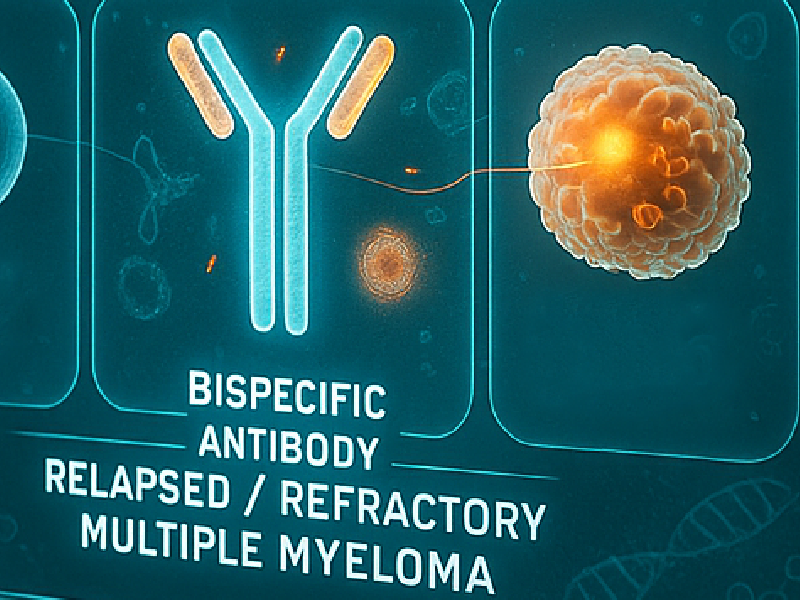
Bispecific antibodies (BsAbs) are engineered antibodies with 2 specificities. In the case of those used for multiple myeloma (MM), 1 arm of the antibody targets an antigen on the myeloma cell surface (eg, BCMA or GPRC5D), and the other arm targets CD3, a component of the T-cell receptor. BsAb binding brings myeloma cells and T-cells together, leading to T-cell activation and killing of the myeloma cell.

FDA Indications and Use of BsAbs

Carol Ann Huff, MD:
The 4 FDA-approved BsAbs for MM are elranatamab, linvoseltamab, talquetamab, and teclistamab. Of these, elranatamab, linvoseltamab, and teclistamab target BCMA, and talquetamab targets GPRC5D. When used as monotherapies, these BsAbs are indicated for patients with relapsed/refractory (R/R) MM after ≥4 prior lines of therapy, including a proteasome inhibitor (PI), immunomodulatory drug (IMiD), and an anti-CD38 monoclonal antibody (mAb).

As single agents, all approved BsAbs have been shown to produce high response rates and durable responses. In the phase II MagnetisMM-3 trial, elranatamab resulted in an objective response rate (ORR) of 61%, with a median duration of response (DoR) not reached in patients without prior BCMA-directed treatment. Elranatamab resulted in an ORR of 46% for patients who received any prior BCMA-directed therapy, 42% after a prior BCMA-directed antibody–drug conjugate (ADC), and 53% after prior BCMA-directed CAR T-cell therapy. This result is important because as the treatment landscape for R/R MM changes, healthcare professionals (HCPs) will need to understand how to sequence BsAbs with other therapies. In the phase I/II MajesTEC-1 trial, patients with R/R MM who were treated with teclistamab had an ORR of 63%, with a median DoR of 24 months. In the phase I/II LINKER-MM1 trial, linvoseltamab resulted in an ORR of 71%, with a median DoR of 29 months. Finally, in the phase II MonumenTAL-1 trial, patients treated with talquetamab had an ORR of 74% and a median DoR of 9.5 months with weekly dosing and 70% and 17.5 months, respectively, with biweekly dosing.

More recently, teclistamab was approved in combination with the anti-CD38 mAb daratumumab for patients with R/R MM who received ≥1 prior line of therapy, including a PI and IMiD. This approval was based on the results of the phase III MajesTEC-3 trial. In this trial, the combination of teclistamab plus daratumumab was shown to improve progression-free survival when compared with daratumumab/pomalidomide/dexamethasone or daratumumab/bortezomib/dexamethasone in patients with R/R MM who received 1-3 prior lines of therapy, including a PI and lenalidomide and no prior BCMA-directed therapy.

In addition to BsAbs, patients with R/R MM have several available treatment options including CAR T-cell therapies (idecabtagene vicleucel and ciltacabtagene autoleucel) and the combination of belantamab mafodotin (a BCMA-directed ADC) with bortezomib and dexamethasone. When several treatment options are available, it is important to engage in shared decision-making with patients to select the most appropriate therapy based on the patient’s medical history and prior therapies, as well as patient preference, lifestyle, and social factors. On the HCP side, familiarity with treatment and institutional availability also impact treatment choice. When weighing the option of using a BsAb or CAR T-cell therapy, BsAbs are appropriate options for patients reluctant to take CAR T-cell therapies due to toxicity concerns, for patients for whom CAR T-cell therapy is inaccessible, and for those with rapid disease progression who cannot wait for the CAR T-cell manufacturing period.

BsAb Dosing Considerations

Sagar Lonial, MD, FACP, FASCO:
All approved BsAbs for MM require step-up dosing, albeit schedules vary slightly, before reaching the target dose. Once at the target dose, teclistamab and elranatamab are dosed weekly. Linvoseltamab is dosed weekly until Week 14 and then biweekly. Talquetamab offers the flexibility of weekly or biweekly dosing at the target dose. The BCMA-directed BsAbs have the added benefit of reduced dosing frequency based on response. Teclistamab can be dosed biweekly in patients who have achieved and maintained at least complete response for a minimum of 6 months. Elranatamab can be reduced to biweekly dosing at Week 25 in patients who have achieved and maintained at least partial response for ≥2 months and further reduced to monthly in patients who have maintained the response following 24 weeks at the biweekly dosing schedule. Linvoseltamab can be reduced to monthly dosing if at least very good partial response is achieved at Week 24 and the patient has received ≥17 doses at the target dose. Currently, BsAbs are recommended to be given until disease progression or unacceptable toxicity. The ongoing trial LimiTEC (NCT05932680) is investigating the possibility of limited-duration therapy with teclistamab. 

Adverse Events With BsAbs

Carol Ann Huff, MD:
The rate of neurotoxicity with BCMA-directed BsAbs ranges from 54% to 60%, with the rate of immune effector cell–associated neurotoxicity syndrome (ICANS) being low, at 3% to 8%. Similarly, in clinical trials, the rates of neurotoxicity, including ICANS and recurrent ICANS with talquetamab, were 55% and 3%, respectively. Patients receiving BsAbs should be frequently monitored for neurologic symptoms such as cognitive impairment, seizures, and altered consciousness, which can be indicative of ICANS. Management for ICANS includes corticosteroids and antiseizure medications. For ICANS, dose holds and reductions should be employed according to the respective prescribing information.

Signs of cytokine release syndrome (CRS) include fever and low blood pressure. The rate of CRS with BsAbs approved for MM can range from approximately 45% to 75%. One way to minimize the risk of CRS is with step-up dosing. If grade ≥2 CRS is confirmed, the IL-6 receptor inhibitor tocilizumab can be used to manage symptoms. Prophylactic use of tocilizumab was also shown to reduce the rate of CRS with teclistamab in the MajesTEC-1 trial. As such, prophylactic tocilizumab is now increasingly used to reduce the rate of CRS with other BsAbs. Dose modifications may also be used to mitigate CRS depending on severity.

In clinical trials, the rate of serious infections with BCMA-directed BsAbs ranged from 30% to 42%, and for talquetamab, the rate of serious infection was 16%. Several measures are employed to reduce the risk of serious infection with BsAb therapy. All patients should receive prophylaxis for herpes simplex or varicella zoster viruses and Pneumocystis jirovecii pneumonia. Prophylaxis for bacterial and fungal infections may be prescribed as needed for patients at high risk of infection, such as those with prolonged neutropenia. Patients with MM receiving BsAbs should also receive intravenous immunoglobulin replacement for the duration of treatment to prevent hypogammaglobulinemia, even in the absence of life-threatening infections. Some experts are advocating for its use irrespective of serum IgG levels.

Fatigue is a bothersome and sometimes overlooked side effect of BsAbs. Rates of any-grade fatigue reported with BsAbs range from 34% to 43%, and rates of grade 3/4 fatigue are as high as 6%. HCPs should discuss with patients that fatigue may initially worsen with BsAb treatment and offer nonpharmacologic interventions for managing fatigue (eg, light therapy, physical activity). 

Talquetamab poses the unique risk of oral and nail toxicities not seen with BCMA-targeted BsAbs. In addition, the risk of skin toxicities is higher with talquetamab than with elranatamab. In clinical trials, approximately 62% of patients experienced skin reactions and 50% developed nail disorders with talquetamab. Eighty percent of patients treated with talquetamab experienced oral toxicities (eg, dysgeusia, dry mouth, dysphagia, and stomatitis). Supportive care measures such as saliva substitutes and sugar-free gum can be used to mitigate oral toxicities, and nutritional supplements can offset weight loss that may occur. In some instances, dose modification may help manage dysgeusia associated with talquetamab treatment. Patients should be advised to use skin emollients and sunscreen to prevent skin reactions. For low-grade rash, patients may use topical corticosteroids. Short doses of oral steroids may be used for more severe rashes that do not respond to topical treatments. Nail hardeners and oils are also useful for combatting nail fragility. 

Outpatient Management of Patients Receiving BsAbs

Sagar Lonial, MD, FACP, FASCO:
Inpatient step-up dosing is recommended for all BsAbs currently approved for R/R MM to mitigate the risk of CRS and ICANS. As a part of the treatment journey, many patients receiving BsAbs will transition from an academic center after step-up dosing to community practice for ongoing therapy. A multidisciplinary team and ongoing communication between the academic and community practices are needed for successful administration of BsAbs and seamless transition to community centers. Pharmacists play a key role in coordinating the administration of BsAbs between academic and community practices and providing premedications and prophylaxis as needed. Nurses are highly trusted among patients and are critical to ensuring continuity of care by providing clinical and logistical support and patient education.

More recently, community-based practices have begun exploring the feasibility of outpatient BsAb step-up-dosing and ongoing administration. For this to be successful, several measures must be taken at the institutional level, such as establishing protocols for BsAb administration and pathways for admission for adverse events (AEs), training members of the multidisciplinary care team, and developing resources for providing ongoing patient and caregiver education and support. In addition, steps must be taken to identify patients who are most suitable for outpatient step-up dosing. In general, patients with lower disease burden and few comorbidities may do better with outpatient BsAb administration. Other considerations for outpatient step-up-dosing include caregiver availability and access to ICU-level care. AE management also affects the ability to provide outpatient BsAb administration. Although ICANS is relatively rare and prophylactic tocilizumab administration greatly reduces the risk of CRS, symptom monitoring remains important. Patients should be educated and equipped to monitor their temperature and blood pressure periodically at home. Some centers utilize a remote patient monitoring system that transmits blood pressure and temperature readings taken while the patient is at home directly to HCPs. In the event of abnormal readings, HCPs can advise patients on how to manage side effects at home or direct them to the emergency department for specialized care. Unlike CRS and ICANS, infections with BsAbs are delayed toxicities that are more likely to occur during outpatient treatment with BsAbs. Patients should receive standard infection prophylaxis and intravenous immunoglobulin as recommended and be educated on the signs of infection. The shift to outpatient step-up dosing can increase accessibility of BsAbs, but careful planning is needed for implementation. 

Conclusions

Carol Ann Huff, MD:
BsAbs have revolutionized the care for patients with R/R MM. As the number of available BsAbs continues to expand, HCPs must consider factors such as target, dosing schedules, institutional availability, and patient preferences when selecting agents. In addition, HCPs must be proactive in managing AEs to ensure safe integration of BsAbs into routine practice. As our experience with BsAbs increases, I look forward to the ongoing transition of BsAb administration from the inpatient setting to the outpatient setting, improving patient access to these important therapies.

In addition to the information provided here, stay tuned for an interactive decision support tool for managing patients with R/R MM with BsAbs. 

Your Thoughts
What are some of the biggest challenges that you face related to the use of BsAbs for R/R MM? Answer the polling question and join the conversation in the discussion below.

Poll

1.

What topic on the use of BsAbs for MM would you like to learn more about? 

Submit